The Anatomy
The anatomy of a shift
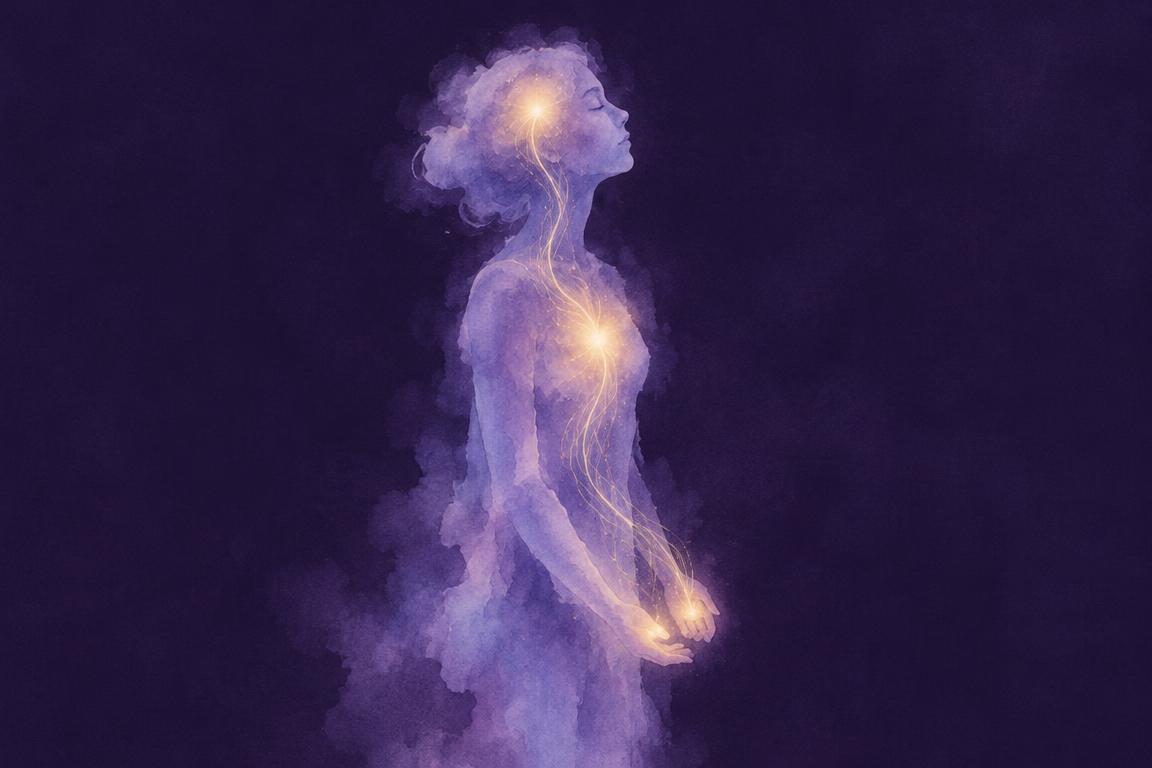
A physical map of how a shift moves through you: Breathe → Tap → Notice → Shift → Write → Remember, traced from body signals through neural pathways into awareness, reflection, and pattern recognition.
 01
01The anatomy of a Tap to Shift
A physical map of how breathing, touch, awareness, writing, and memory move through the body and brain.
Tap to Shift can be viewed as a sequence of physical and neural events. Signals begin in the body, travel through the nervous system, reach the brain, enter awareness, and can then be organized through reflection and memory.
Breathe
Breathing begins with respiratory muscles, especially the diaphragm. The diaphragm is controlled primarily through the phrenic nerves, while respiratory rhythm is coordinated by networks in the medulla and pons of the brainstem. Breathing also interacts continuously with heart rate, blood pressure, and autonomic activity.
Tap
Light tapping deforms the skin and activates mechanoreceptors that detect touch, pressure, movement, and vibration. Sensory information then travels through peripheral nerves toward the spinal cord or, for much of the face, through the trigeminal sensory system.
Notice
Somatosensory and internal-body signals are integrated across the brainstem, thalamus, insula, somatosensory cortex, anterior cingulate cortex, and other networks. Directing attention toward these signals can bring information that was already being processed into conscious awareness.
Shift
Attention is controlled by distributed networks involving frontal, parietal, insular, cingulate, and subcortical regions. Breathing and touch introduce present-moment sensory information that can compete with repetitive thought for attentional priority.
Write
Writing requires the brain to hold information in working memory, organize it, select language, and produce a physical response through the hands. An internal experience becomes something that can be described and examined.
Remember
Memory systems, including the hippocampus and distributed cortical networks, help store and retrieve experiences. Across repeated check-ins, individual experiences can begin forming recognizable patterns.
Body signal → neural pathway → awareness → reflection → memory → pattern recognition.
 02
02Breathing: diaphragm, brainstem & autonomic signaling
Following the physical pathway from respiratory movement to brain and cardiovascular regulation.
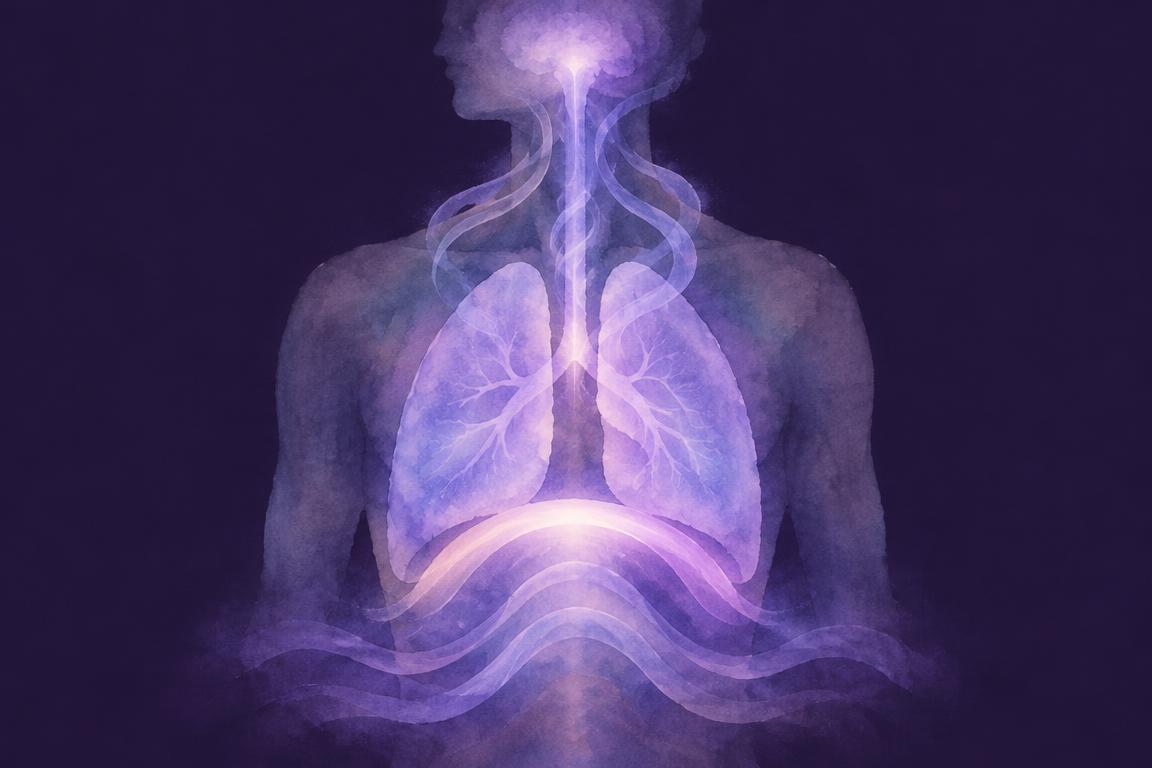
Breathing is both automatic and voluntarily adjustable, making it an unusual connection between conscious behavior and physiological regulation.
The diaphragm begins the movement
During inhalation, the diaphragm contracts and moves downward, increasing the volume of the chest and drawing air into the lungs. Motor signals reach the diaphragm mainly through the phrenic nerves, which arise from cervical spinal cord segments C3 through C5.
The brainstem generates respiratory rhythm
Networks within the medulla and pons continuously coordinate breathing. These brainstem systems receive information about blood gases, lung inflation, cardiovascular state, and other physiological conditions and adjust breathing accordingly.
The body also sends information back
Breathing is not a one-way command from brain to lungs. Sensory information from the respiratory and cardiovascular systems travels back toward the central nervous system through multiple pathways, including vagal and glossopharyngeal afferents.
The nucleus tractus solitarius
A major brainstem relay for visceral information is the nucleus tractus solitarius, or NTS, in the medulla. It receives sensory information from internal organs and participates in networks involved in breathing, heart rate, blood pressure, and autonomic regulation.
Breathing and the heart interact
Heart rate normally changes across the respiratory cycle. This respiratory–cardiac interaction contributes to respiratory sinus arrhythmia and measures of heart-rate variability. Controlled slow breathing can alter these cardiovascular and autonomic patterns.
What this means inside Tap to Shift
Following a slower breathing rhythm gives attention a physical anchor while respiratory, cardiovascular, and autonomic systems continue interacting beneath conscious awareness. A brief practice is not a complete physiological reset, but it can begin changing respiratory rhythm and provide a different stream of bodily information to notice.
Breathing links conscious attention with a physiological system that is already continuously regulated by the brain and body.
 03
03Tapping: from skin receptors to somatosensory cortex
The anatomical pathway that turns a light tap into a conscious sensation.
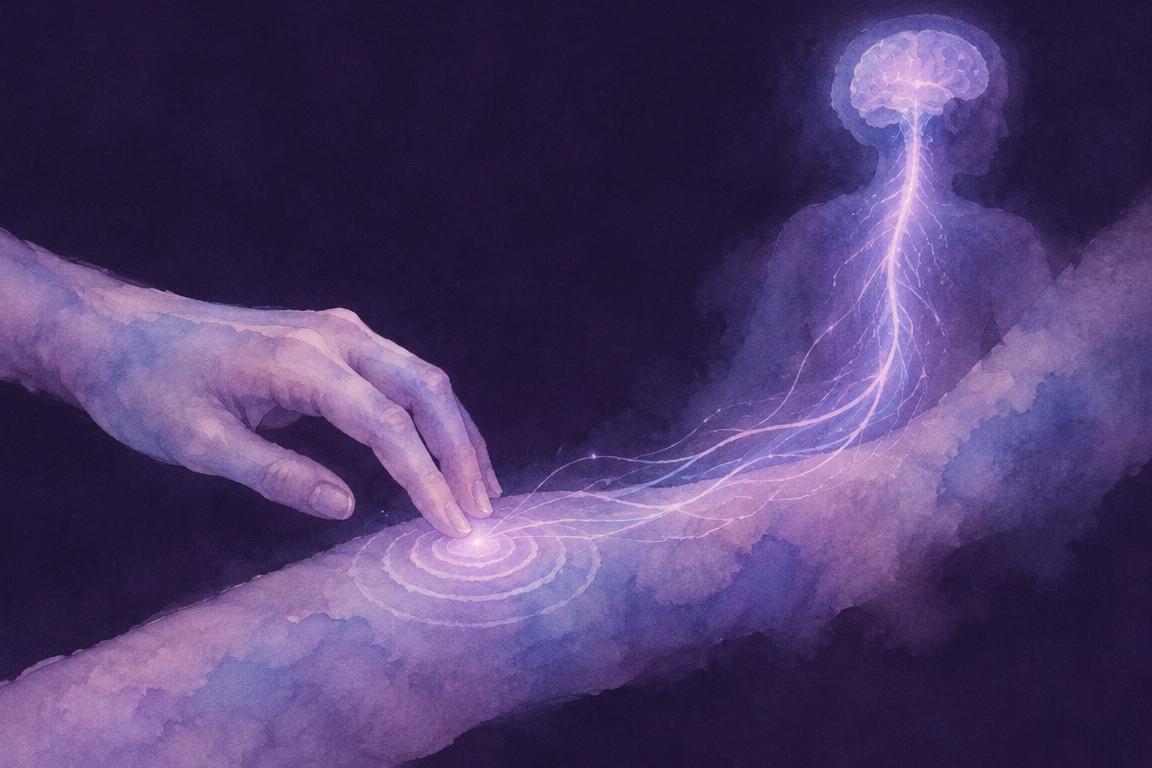
A tap begins as mechanical pressure on the skin and becomes electrical activity within the nervous system.
Mechanoreceptors detect the contact
The skin contains specialized mechanoreceptors that respond to features such as pressure, vibration, movement, and skin deformation. Low-threshold mechanoreceptors transmit ordinary touch without requiring painful stimulation.
Peripheral sensory nerves carry the signal
Touch information is carried by sensory nerve fibers, including large myelinated Aβ fibers involved in many forms of non-painful touch and pressure. For the body, the cell bodies of these sensory neurons are located in the dorsal root ganglia beside the spinal cord.
The signal enters the spinal cord
Much discriminative touch information from the body enters the spinal cord and ascends through the dorsal columns. Signals from the lower body travel mainly through the fasciculus gracilis, while upper-body signals travel through the fasciculus cuneatus.
The medulla relays the information
These fibers synapse in the gracile and cuneate nuclei of the medulla. Second-order neurons then cross the midline and ascend through the brainstem as the medial lemniscus.
The thalamus routes the signal
Body touch information reaches the ventral posterolateral nucleus of the thalamus. The thalamus acts as an important relay before this information continues toward the cerebral cortex.
The somatosensory cortex represents the body
Signals ultimately reach the primary somatosensory cortex in the postcentral gyrus. Different regions of this cortex represent different parts of the body, allowing the brain to identify where the tapping occurred and characteristics of the sensation.
The face uses another route
Touch from much of the face is carried primarily through the trigeminal sensory system, associated with cranial nerve V, rather than through the spinal dorsal-column pathway.
Skin → sensory nerve → spinal cord or trigeminal pathway → thalamus → somatosensory cortex → conscious touch.
 04
04Interoception: how internal signals reach awareness
The pathways that help the brain construct a representation of what is happening inside the body.
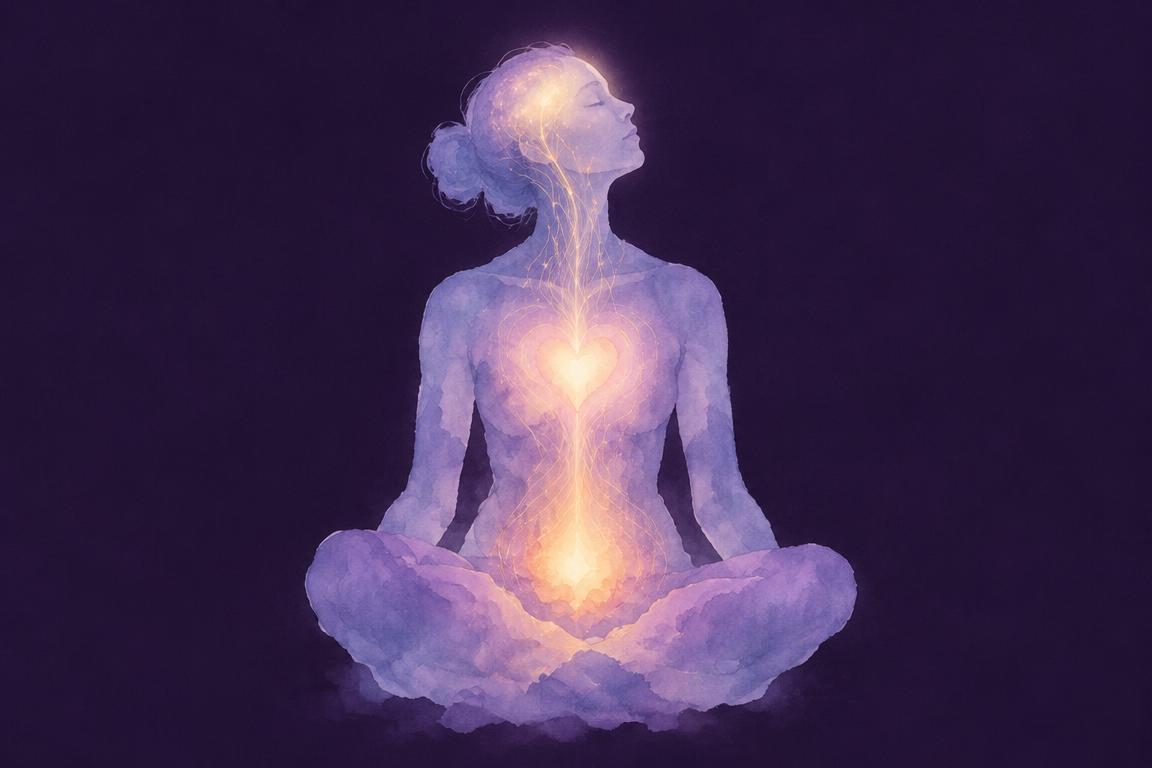
Your nervous system continuously receives information from inside your body, even when you are not consciously paying attention to it.
Internal organs generate sensory information
The cardiovascular, respiratory, digestive, metabolic, and other internal systems continuously produce physiological signals. Specialized sensory endings detect changes such as stretch, pressure, chemical conditions, temperature, and organ state.
Visceral afferents carry information inward
Internal-body information travels toward the central nervous system through spinal visceral afferents and cranial pathways, including the vagus and glossopharyngeal nerves.
Brainstem integration begins early
The nucleus tractus solitarius receives large amounts of visceral sensory information. Other brainstem and subcortical structures participate in integrating internal physiological state before that information ever becomes a conscious feeling.
Signals move into higher networks
Interoceptive processing involves pathways connecting the brainstem with regions including the thalamus, hypothalamus, parabrachial area, insula, anterior cingulate cortex, and other cortical networks.
The insula helps integrate bodily state
The insular cortex is strongly associated with integrating physiological information with attention, emotion, and subjective experience. It is important to think of interoception as a distributed system rather than a function belonging to one single brain region.
Attention can make a background signal noticeable
A signal can be processed by the nervous system without becoming the focus of awareness. When Tap to Shift asks you to notice breathing, tension, pressure, warmth, or other sensations, attention is being directed toward information that may previously have remained in the background.
Interoception is the nervous system sensing the body; body awareness is part of becoming conscious of those signals.
 05
05Attention: how the brain redirects processing
Why a breath or physical sensation can become a new target for conscious attention.
Attention is not located in one part of the brain. It emerges from coordinated activity across multiple neural networks.
The brain cannot prioritize everything equally
At every moment, the brain receives enormous amounts of sensory, internal, emotional, and cognitive information. Attention helps determine which information receives greater processing priority.
Frontal and parietal networks participate
Frontal and parietal regions are strongly involved in goal-directed attention, maintaining focus, and deliberately shifting attention from one target to another.
Salience matters too
The anterior insula and anterior cingulate cortex are frequently associated with detecting and prioritizing information that is behaviorally or internally important. These systems interact with broader attention and control networks.
Repetitive thought can capture attention
When someone is absorbed in worry or repetitive thinking, cognitive content can repeatedly capture conscious priority. The thought may continue receiving attention even when other bodily information is available.
Tap to Shift introduces competing sensory information
Breathing rhythm, touch, pressure, movement, and body sensation create immediate sensory targets. The original thought has not necessarily disappeared, but it is no longer the only information available for focused processing.
Redirection creates an observational position
Once attention includes both the thought and the body, the user may be able to observe the experience rather than remain completely absorbed by it.
The shift is a change in attentional priority, not necessarily the elimination of a thought.
 06
06Writing: from sensation to language
How an internal experience becomes organized into words and conscious reflection.
Writing transforms part of an internal experience into an external symbolic representation.
First, the experience must be held in mind
Working-memory and executive systems help maintain information long enough for you to examine it and decide what you want to express.
Language networks organize meaning
Producing language relies on distributed networks across frontal, temporal, and parietal cortices. These systems help select words, construct meaning, and relate current experience to stored knowledge.
Prefrontal systems support organization
Prefrontal networks contribute to attention, working memory, planning, inhibition, and organization. Writing requires these systems to help structure an experience that may initially feel diffuse or difficult to describe.
The hand completes the physical loop
Typing or handwriting also recruits motor-planning and motor-output systems. The thought is converted into a physical action and appears externally as language that can be reread and examined.
Naming changes how the experience is represented
A vague state such as “something feels wrong” can become more specific: “My chest tightened when I thought about tomorrow.” That does not necessarily remove the feeling, but it changes the experience from something only felt into something that can also be described and reflected upon.
Why writing comes after noticing
Tap to Shift first gives the user an opportunity to attend to breathing and sensation. Writing then invites the user to translate part of that bodily and cognitive information into their own language.
Sensation → awareness → working memory → language → reflection.
 07
07How the brain connects experience, body & memory
The neural systems involved in connecting what happens around you with what you experience within you.
“What’s Going On?” invites you to notice a situation alongside your thoughts, emotions, body sensations, and reflections. Several interacting brain networks help process these different parts of experience. No single brain region determines what an event means to you.
The brain processes what is happening around you
When something happens, your brain processes information from your senses and combines it with attention, memory, expectations, and previous experiences. Sensory and association areas, together with frontal and other networks, help you recognize what is happening and what may be relevant to you. This is part of how an external situation becomes something you consciously experience.
Emotional significance involves multiple brain networks
The amygdala participates in detecting and learning about emotionally significant information, including potential threats and rewards. The prefrontal cortex, insula, anterior cingulate cortex, hippocampus, and other regions also contribute to emotional processing and interpretation. The amygdala is not simply a fear center, and no single brain region determines your emotional response.
The body participates in the experience
Emotional experiences can involve changes in breathing, muscle tension, heart activity, digestion, and other bodily processes. Information about internal physiological states travels through multiple neural pathways, including those involved in interoception. The insula and other brain networks help integrate some of this bodily information with attention and subjective experience. A body sensation does not have one fixed emotional meaning.
The hippocampus helps connect an experience with its context
The hippocampus is important for episodic and contextual memory. It helps support remembering aspects of an experience, including what happened and the circumstances surrounding it. However, remembering is reconstructive. Details can become less accessible or change over time. Recording what you noticed gives you an external reference that does not depend entirely on later recall.
The prefrontal cortex supports reflection and comparison
Prefrontal networks contribute to working memory, attention, organizing information, and comparing experiences. When you reflect on what happened, what you felt, and what you noticed in your body, these processes can help you hold different pieces of information in mind. Writing also engages language and motor systems, turning some of that experience into words you can revisit.
Saved reflections create an external memory record
Your brain does not store a saved reflection inside the hippocampus simply because you used an app. Instead, Tap to Shift provides an external record of what you chose to capture. When you revisit that record, memory, attention, and reasoning systems can help you compare it with other experiences. This may make recurring relationships easier to recognize without establishing that one event caused a particular response.
The brain processes. You create the meaning.
“What’s Going On?” does not read neural activity or determine what caused your feelings. It helps you bring different parts of an experience into one place, where you can examine them together.
Life context → sensory and emotional processing → body signals → awareness → reflection → memory → pattern recognition.
 08
08Memory: hippocampus, learning & pattern recognition
How repeated experiences can become a recognizable map of your own responses.
Remembering is what allows separate moments to become connected across time.
The hippocampus supports episodic and contextual memory
The hippocampus is important for forming and retrieving memories of events and their context: what happened, where it happened, and what was occurring around the experience.
Memory is distributed
Long-term memory is not stored in one brain location. The hippocampus interacts with widespread cortical networks involved in sensory information, emotion, language, knowledge, and context.
The prefrontal cortex helps use previous information
Prefrontal networks contribute to retrieving relevant information, comparing experiences, identifying relationships, and using previous learning to guide current decisions.
One experience becomes part of a larger dataset
One check-in may reveal: “My shoulders are tense.” Another may reveal the same sensation during a similar situation. Repeated observations create more information that can be compared.
Patterns emerge through repeated association
Over time, the user may recognize relationships between context, body sensations, thoughts, emotions, and behavior. For example: “My shoulders tend to tighten when I feel criticized.”
Earlier recognition becomes possible
As a pattern becomes familiar, the user may recognize an early signal sooner. This does not mean the nervous system has been permanently changed by a single session. It means repeated experience has produced information that can be recognized and retrieved.
Memory turns isolated moments of awareness into information that can be recognized across time.
 09
09The complete pathway
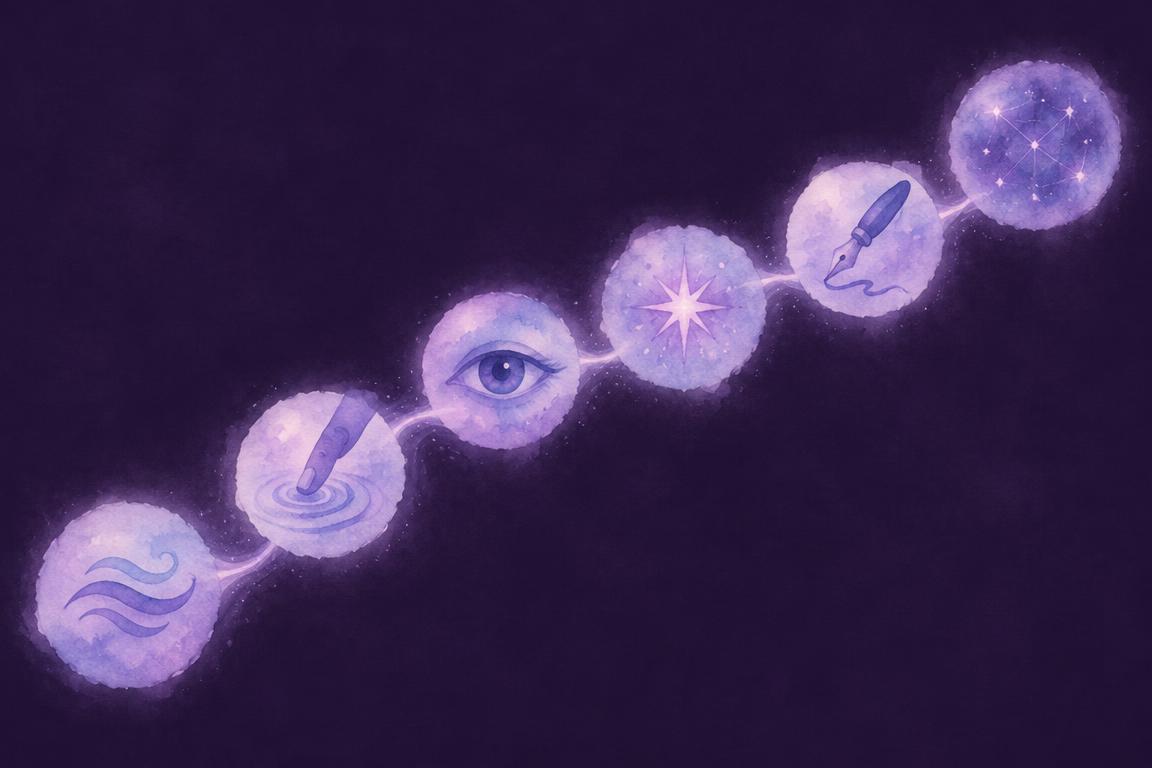
Breathe → Tap → Notice → Shift → Write → Remember.
The full Tap to Shift process can be mapped as a progression from physical signals to conscious awareness, reflection, and learning.
1. Breathe — respiratory and autonomic physiology
Diaphragm and respiratory muscles → lungs → respiratory and cardiovascular sensory feedback → brainstem networks including the NTS → ongoing autonomic and cardiorespiratory interaction.
2. Tap — somatosensory input
Skin mechanoreceptors → peripheral sensory nerves → dorsal root ganglia and spinal pathways, or trigeminal pathways for much of the face → brainstem → thalamus → primary and higher somatosensory cortices.
3. Notice — conscious body awareness
Somatosensory and visceral information → brainstem and thalamic relays → insular, cingulate, somatosensory, and related cortical networks → conscious awareness of sensation and internal state.
4. Shift — attentional redirection
Frontal, parietal, salience, and control networks redistribute attentional priority so repetitive thought is no longer the only information occupying focused awareness.
5. Write — cognitive organization
Awareness → working memory → language and executive networks → motor output → an internal experience becomes an external description that can be examined.
6. Remember — memory and learning
Hippocampal and cortical memory systems → retrieval and comparison across experiences → recurring relationships become recognizable patterns.
What the sequence is designed to accomplish
Tap to Shift does not need to tell the nervous system what it is experiencing. The nervous system is already generating information. The sequence is designed to help the user attend to, organize, and remember more of that information.
The app provides the sequence. The body provides the signals. The brain processes the information. You create the awareness.