The Practice
What is Tap to Shift?
A quiet space to notice what is happening within you. These articles explain the practice in plain language — why breathing comes first, what gentle tapping does, and why the app guides while you create the awareness.
 01
01What is Tap to Shift?
A quiet space to notice what is happening within you.
Tap to Shift is a self-awareness app built for nervous system support.
The idea is simple
Tap to Shift guides you through a simple process: breathe, tap, notice, write, and remember. The goal is not to tell you what you should think, feel, or do. It gives you a moment to slow down and notice what is already happening inside you.
The app guides. You create the awareness.
Tap to Shift gives you structure, but your experience still belongs to you. You notice your breath, your body, your thoughts, your reactions, and what may be asking for your attention.
Notice before you react
Awareness can create a little more space between what you are experiencing and what you choose to do next.
Sometimes awareness is the first shift.
 02
02Why breathing first?
A simple way to slow down and return attention to your body.
Your breath is always with you, which makes it one of the simplest places to begin.
A physical point of focus
When your mind feels busy, following your breathing gives your attention something simple and physical to return to.
Slow breathing
Slow breathing can influence the relationship between breathing, heart rate, and the body’s stress-response systems. Research on slow breathing often uses several minutes of practice, so Tap to Shift does not treat a short breathing session as a guaranteed nervous system reset.
Why keep it brief?
The practice is intentionally short so it can fit into everyday life. You are creating a pause, not trying to achieve a perfect state.
A small pause can still be meaningful.
 03
03What is gentle tapping?
Using simple touch to bring attention back into your body.
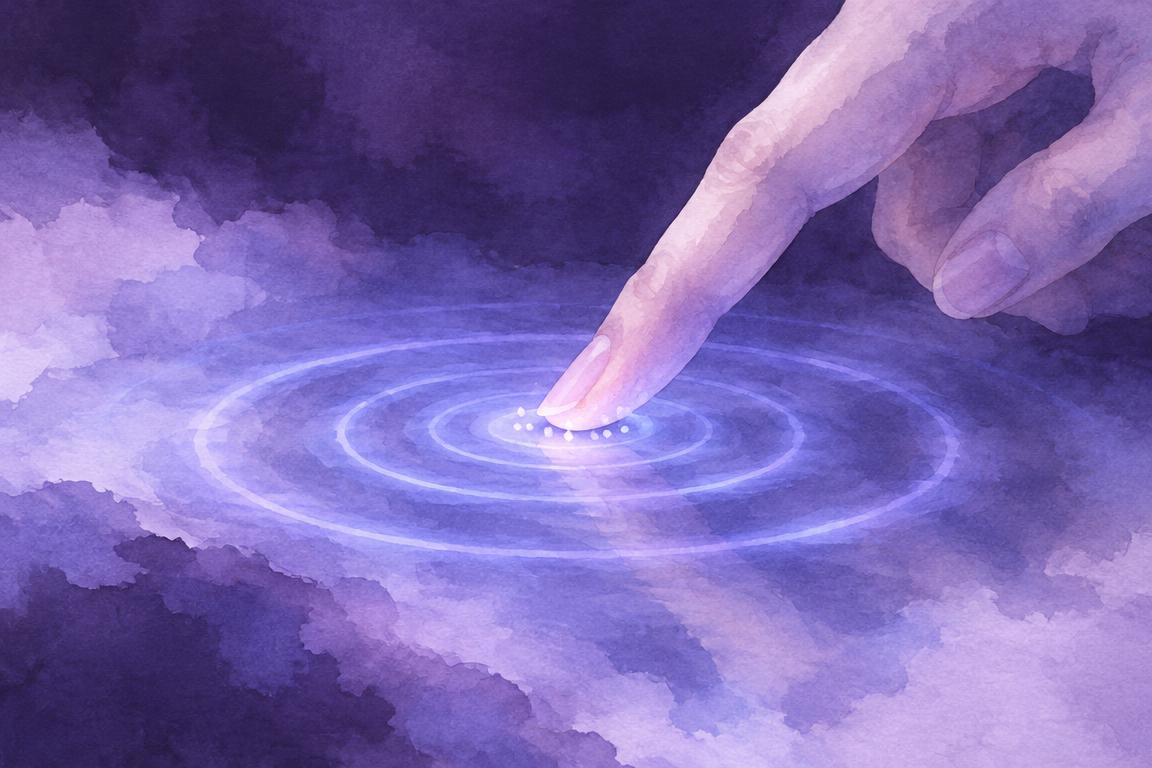
Gentle tapping is a simple sensory practice using your fingertips.
How it works
Use your fingertips to lightly tap the area shown. Keep tapping slowly and gently until the timer ends.
Why use touch?
Touch gives your brain physical sensory information from the body. By paying attention to a simple repetitive sensation, your attention has somewhere physical to return to.
The location is not magic
Tap to Shift does not treat individual tapping points as having special powers. The practice is about gentle touch, repetition, body awareness, and attention.
Keep it soft, slow, and comfortable.
 04
04Why only a short time?
Because a pause does not have to be long to be useful.
Tap to Shift keeps its breathing and tapping practices intentionally brief.
You are not trying to fix everything
A short practice is not meant to completely change your emotional state or guarantee nervous system regulation. It is meant to create a pause.
Interrupt the momentum
When you are stressed, overwhelmed, or caught in your thoughts, your attention can become narrow and repetitive. A brief breathing and tapping practice gives your attention somewhere else to go.
You can continue if you want
For some people, a short pause may feel like enough. Others may want more time. Tap to Shift keeps the first step small so you can decide what you need next.
A minute does not have to fix everything to change the direction of your attention.
 05
05Why attention matters
Sometimes the shift begins with where your attention goes.
When your mind is overwhelmed, your attention can become locked onto thoughts, problems, fears, or possibilities.
You do not have to fight the thought
Tap to Shift is not asking you to force a thought away or replace it with a positive one.
Give attention somewhere else to go
First, your breath. Then, physical sensation through tapping. Then, awareness of what you are noticing. That small redirection can create enough space to see your experience differently.
This is the shift
The goal is not always to change the thought. Sometimes it is simply to change where your attention goes long enough to become aware of what is happening.
Attention can be redirected without forcing anything away.
 06
06Why tune into your body?
Your body is part of the conversation.
Your mind is not the only place where your experience shows up.
Your body may signal first
You may notice tension in your shoulders, changes in your breathing, restlessness, heaviness, warmth, tightness, or the urge to move before you fully understand what is happening.
You do not need to analyze everything
Tuning into your body does not mean every sensation needs an explanation. Sometimes the practice is simply noticing what is there.
Familiarity builds awareness
The more familiar you become with your own signals, the easier it may become to recognize your patterns earlier.
Your body is part of the conversation.
 07
07What is “What’s Going On?”
Give what is happening in your life a place to be noticed, understood, and remembered.
“What’s Going On?” is part of the Tap to Shift practice. It helps you move from simply noticing that something is affecting you to seeing more clearly what may be happening around you and within you.
How can this help me?
Life happens quickly. You can go through a difficult conversation, pressure at work, money concerns, changes at home, relationship tension, uncertainty, excitement, or several things at once — and continue moving through your day. Later, you may know: “I feel overwhelmed.” “I’m irritated.” “My body feels tense.” “I can’t stop thinking about something.” “I’ve just felt off all day.” But you may not clearly remember everything that contributed to it. “What’s Going On?” helps you slow the experience down and put the pieces somewhere you can see them. Instead of only knowing that something is affecting you, you have a place to notice what happened, what you felt, what you noticed in your body, what may be underneath it, and what you eventually realized. You do not have to solve everything. Sometimes simply being able to see what has been affecting you can help you make more sense of your experience.
Your experience has a context
Your thoughts, emotions, and body do not exist separately from everything happening in your life. A conversation, relationship, work, money, home, uncertainty, change, something you are anticipating, or several experiences happening together may all become part of what you are carrying. Sometimes you notice the effect before you notice the context: “I’m irritated.” “My chest feels tight.” “I can’t stop thinking.” “I’ve felt off all day.” “What’s Going On?” gives you a place to notice what was happening around you alongside what was happening within you.
Give the experience a container
As life continues, experiences can begin blending together. Something happens in the morning. Something else happens at work. Another thought comes up later. Your body responds. Your mood changes. By the end of the day, it can become one tangled experience. “What’s Going On?” gives those pieces somewhere to go: What happened? What am I feeling? What am I noticing in my body? What seems to be underneath this? What am I realizing now? What might the wisest version of me choose or do next? You do not need perfect answers. You are simply making more of your experience visible to yourself.
Remember what you might otherwise forget
Something can feel incredibly important today and become difficult to reconstruct several days later. You might remember: “Tuesday was a difficult day.” But not necessarily: “This happened. This is what I felt. This is what I noticed in my body. This is what seemed to be underneath it. And this is what I realized.” Saving your reflection preserves a snapshot of what you noticed at the time. Instead of depending only on memory later, you have something you can return to.
Bring what was unnoticed into awareness
Sometimes something can affect you before you fully recognize how much influence it has been having. When you see the situation alongside your thoughts, emotions, body sensations, and reflections, connections may become easier to notice: “Oh. That’s what has been bothering me.” “This keeps happening when…” “I didn’t realize how much that situation was affecting me.” Tap to Shift does not decide what those connections mean. The app gives you the structure. You create the awareness.
One moment can become part of a bigger picture
One reflection can help you understand one moment. Repeated reflections may begin making your own patterns easier to see. You might notice that certain situations tend to appear alongside particular thoughts, emotions, body sensations, or reactions. You may also begin noticing what tends to help. The purpose is not to label yourself or make every experience mean something. It is to give you a way to look back and recognize what seems to repeat in your own life.
Bring something concrete into supportive conversations
Sometimes someone asks: “How have things been since we last talked?” You know a lot happened — but suddenly it can be difficult to remember all the details. If you choose to share your reflection, you can bring what you recorded to a therapist, counselor, coach, trusted person, or another support professional. Instead of trying to reconstruct everything from memory, you can begin with: This is what happened. This is what I felt. This is what I noticed in my body. This is what seemed to be underneath it. This is what I realized. Your reflection can become a starting point for a more focused conversation about what matters to you. You decide what you share and with whom.
You are still the one making meaning
“What’s Going On?” does not diagnose you, decide why something happened, or tell you what your experience means. It helps you capture, organize, remember, and revisit your own observations. Because sometimes the first problem isn’t that you don’t have an answer. You may not have had a place to clearly see all the pieces yet.
Life happens quickly. “What’s Going On?” helps you capture what happened, what you experienced, and what you noticed — so you have something to return to when you want to understand yourself more clearly.
 08
08What is self-awareness?
Learning to notice yourself without immediately judging yourself.
Self-awareness is the ability to notice what is happening within you.
What can you notice?
Your thoughts. Your emotions. Your body sensations. Your habits. Your reactions. Where your attention keeps going. What you may need.
Awareness is not judgment
You do not have to immediately fix what you notice. Sometimes the first step is simply recognizing: “This is what is happening in me right now.”
Awareness creates choice
When something becomes visible to you, you have a better opportunity to decide how you want to respond.
Notice first. Decide what comes next.
 09
09Self-awareness & your nervous system
Why noticing your internal signals can matter.
Your nervous system is constantly responding to what is happening around you and within you.
Responses can happen quickly
You may notice faster breathing, muscle tension, restlessness, a tight chest, racing thoughts, or an urge to react.
Recognizing the signal
Self-awareness can help you recognize some of these changes earlier instead of only noticing them after you feel overwhelmed.
Creating a pause
Breathing, gentle tapping, noticing, and reflection can give you a brief opportunity to slow down and observe your experience before deciding what you need next.
Tap to Shift is not asking you to control your nervous system. It is helping you become more aware of yourself while it responds.
 10
10Why writing helps
Putting your experience into your own words.
Sometimes what is happening inside you can feel vague, tangled, or difficult to understand.
Give the experience somewhere to go
Writing can help you slow down, organize what you are experiencing, and put language around thoughts or feelings that may have been difficult to name.
Feel. Notice. Name.
In Tap to Shift, writing comes after breathing, tapping, and noticing for a reason. First you return attention to your body. Then you notice. Then you put your experience into your own words.
Patterns become easier to see
When you write over time, you may begin to notice recurring triggers, thoughts, body signals, reactions, and what tends to help.
Writing does not have to solve the experience. Sometimes putting it into words helps you understand it more clearly.
 11
11Why remembering your patterns matters
Individual moments can become a bigger picture.
A single moment can tell you something. Repeated moments can begin to show you a pattern.
Look back without judgment
Your shifts and reflections can help you notice what tends to happen when you feel stressed, pressured, overwhelmed, calm, connected, or clear.
Notice what repeats
You may begin to recognize familiar triggers, body sensations, thoughts, reactions, or environments.
Remember what helps
Patterns are not only about what feels difficult. You can also begin to notice what helps you return to yourself.
Awareness becomes more useful when you can recognize it over time.
 12
12Why the quiet is intentional
Not every moment needs more stimulation.
Tap to Shift is intentionally quiet.
There is already a lot competing for your attention
Notifications, conversations, videos, music, information, and constant input can fill nearly every quiet moment.
Quiet creates space
Instead of adding another sound for you to follow, Tap to Shift leaves room for you to notice your own breathing, thoughts, sensations, and surroundings.
Technology can also step aside
Sometimes technology can be useful not because it gives us more information, but because it helps create a moment to reconnect with ourselves.
The quiet is intentional — so you can hear yourself.
 13
13Why Tap to Shift does not give you answers
Technology can guide the process without replacing your inner voice.
AI can generate information, ideas, explanations, and answers. Tap to Shift is designed to do something different.
Your inner experience belongs to you
Technology cannot feel your body from the inside. It cannot experience a moment exactly the way you do or decide what that moment truly means to you.
Tap to Shift creates space instead
Instead of immediately filling the space with another answer, the app guides you back toward your own experience.
You create the awareness
You breathe. You feel. You notice. You write. You begin recognizing your own patterns. The app can guide the process, but the awareness comes from you.
AI can generate answers. Tap to Shift helps you generate self-awareness.
 14
14Tap to Shift as a redirection
A small interruption with a purpose.
Sometimes you do not need a long practice. You need a moment that interrupts the pattern.
Think of it as a small snap in attention
When you are caught in overthinking, stress, or automatic reaction, Tap to Shift gives your attention a different direction.
Breathe. Feel. Notice.
For a few minutes, your attention moves away from only following the mental loop and toward your breath, physical sensation, and what is happening within you.
The problem does not have to disappear
The purpose of the pause is not to pretend the situation is gone. It is to create a little space between the pattern and your next response.
A small interruption can be enough to change the direction of your attention.
 15
15What can happen when you keep using Tap to Shift?
Small moments of awareness can build over time.
Tap to Shift is designed to fit into ordinary life, even when you only have a few minutes.
Practice noticing
Each time you pause, breathe, tap, or reflect, you are practicing the skill of noticing yourself.
Become familiar with your signals
Over time, you may become quicker at recognizing things like tension, overwhelm, repetitive thinking, certain triggers, or the early signs that you need a pause.
Recognize your patterns
Repeated reflection can help you notice what tends to activate you, how your body responds, what thoughts appear, and what tends to help you feel more grounded or clear.
Awareness can create more choice
The deeper goal is not to make you dependent on an app. It is to help you become more familiar with yourself so awareness can begin showing up in your everyday life too.
A few minutes at a time can become a practice of knowing yourself better.