The Science
The science behind the shift
A deeper, research-informed look at breathing, touch, attention, body awareness, reflection, and learning — and an honest view of what the evidence does and does not establish.
 01
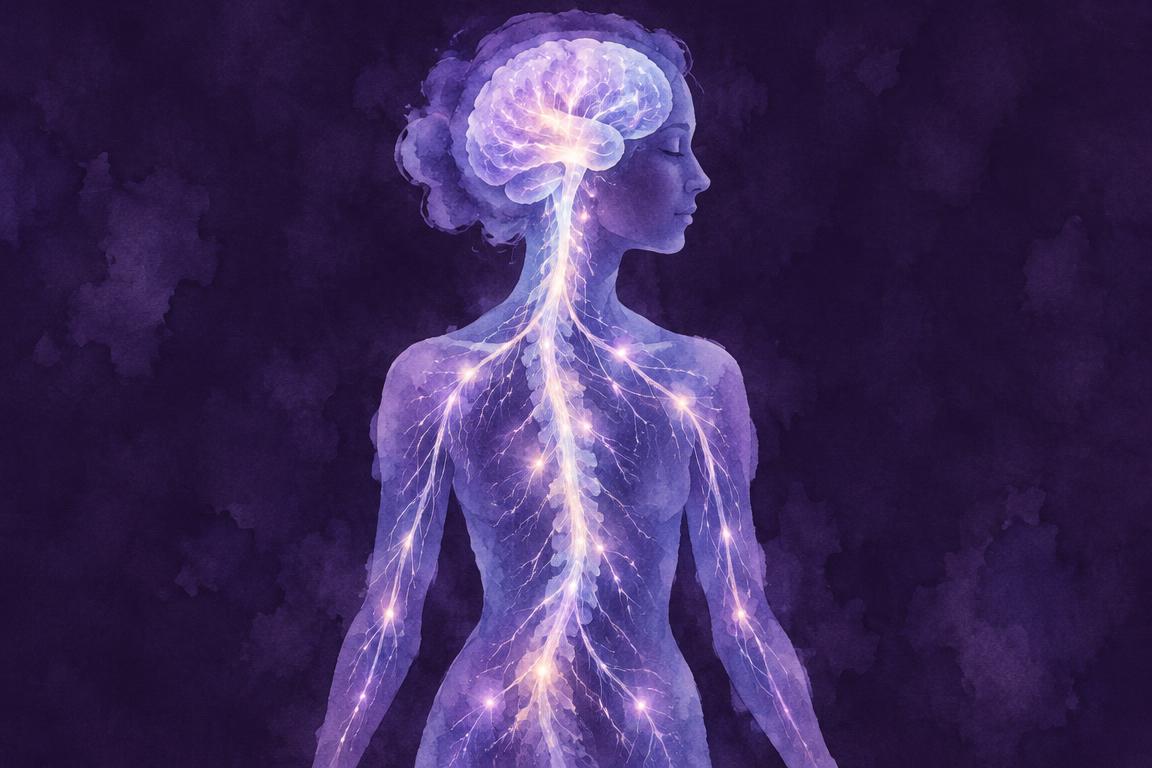
01How Tap to Shift works in the brain and nervous system
A deeper look at breathing, touch, attention, body awareness, reflection, and learning.
Tap to Shift is not based on one single brain mechanism. It combines several simple processes that involve breathing, sensory input, attention, body awareness, reflection, and pattern recognition.
Think of it as a sequence
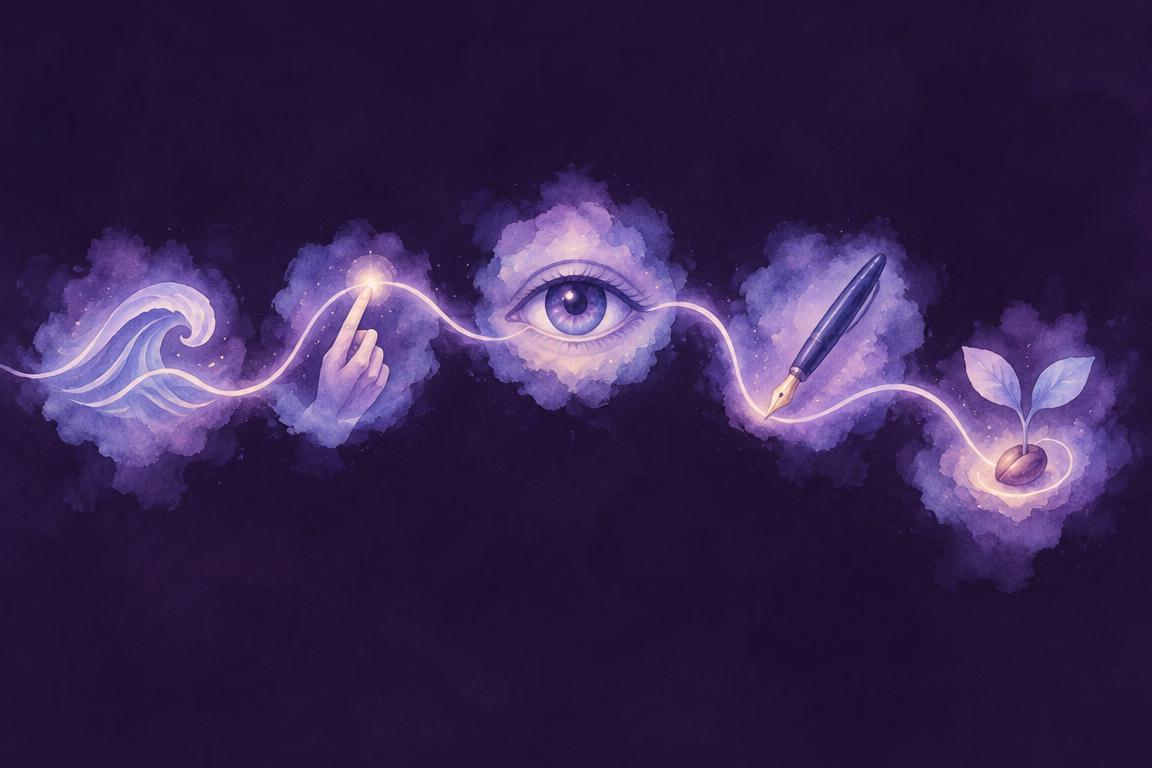
The process moves through several layers: breathing gives you a rhythmic physical focus, tapping adds touch and sensory input, noticing brings attention toward your internal experience, writing helps put that experience into words, and remembering helps you recognize patterns over time.
Different systems are involved
Breathing interacts with respiratory and cardiovascular systems. Touch is processed through sensory pathways. Body awareness involves interoceptive and somatosensory processing. Attention helps determine what information receives priority. Reflection and memory help organize experience and support learning.
The goal is not to control the brain
Tap to Shift does not claim to switch the nervous system on or off. It creates a structured opportunity to pause, redirect attention, notice internal signals, and reflect on what is happening.
Breathing → sensory input → noticing → reflection → pattern recognition.
 02
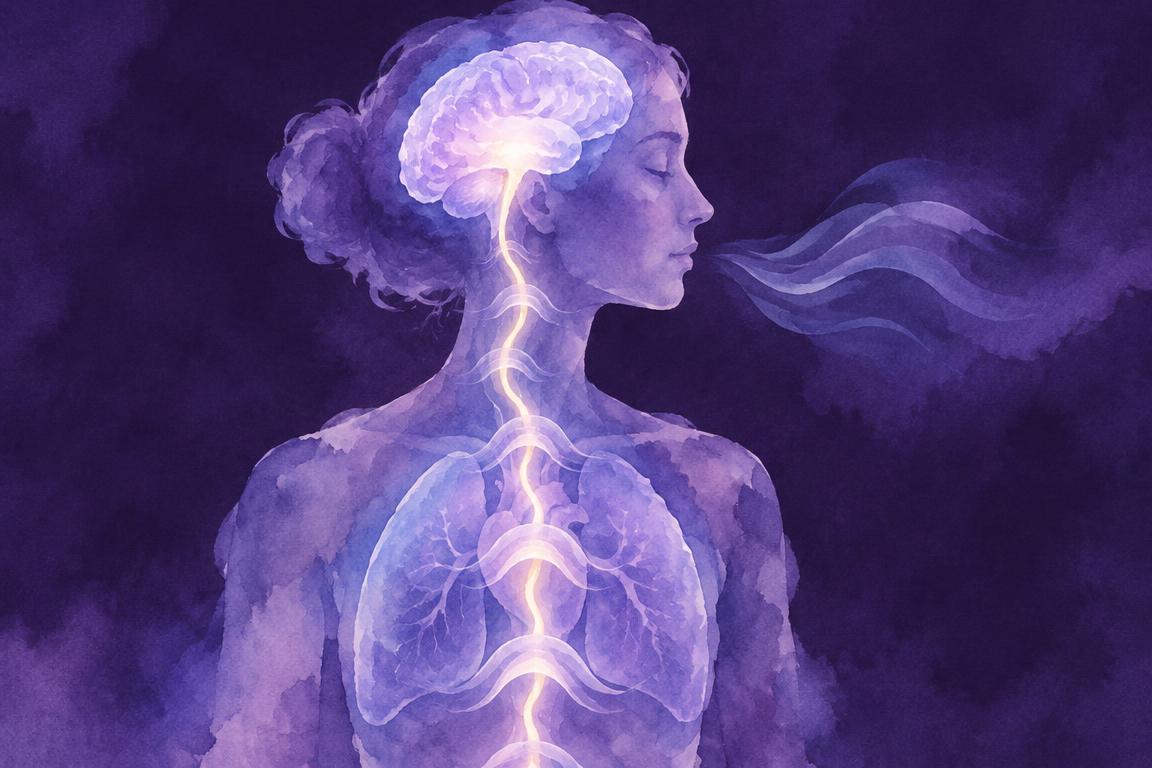
02Breathing & the autonomic nervous system
Why slow breathing can influence systems connected with heart rate and arousal.
Breathing is unusual because it happens automatically, but you can also influence it intentionally.
Breathing and heart activity interact
Your breathing rhythm and heart rhythm are connected. As you breathe in and out, heart rate naturally changes. This relationship is often described through respiratory sinus arrhythmia and other measures of cardiorespiratory interaction.
Slow breathing has measurable effects
Research on controlled slow breathing has found changes in heart-rate variability, respiratory sinus arrhythmia, baroreflex sensitivity, cardiorespiratory coupling, and other measures related to autonomic function.
What Tap to Shift is doing
Tap to Shift begins with breathing because it gives your attention a simple rhythm to follow while also engaging a body system that is closely connected with autonomic activity.
What the evidence supports
Most slow-breathing research uses longer periods than the brief practices in Tap to Shift. A short session is better understood as a brief opportunity to begin slowing down, redirecting attention, and becoming more aware of what is happening in your body.
Breathing is a bridge between something your body does automatically and something you can consciously influence.
 03
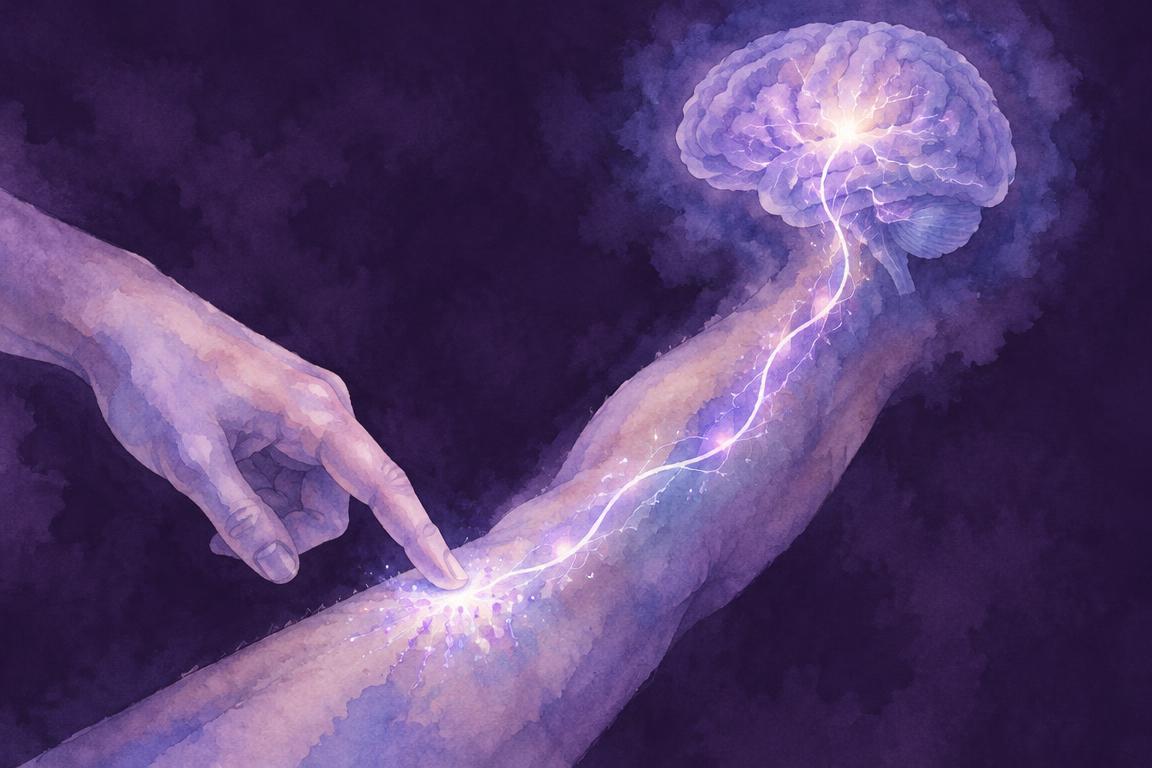
03Touch, tapping & sensory input
What happens when your fingertips create repeated physical sensation.
Your skin is filled with sensory receptors that detect touch, pressure, movement, temperature, and other physical information.
Touch becomes neural information
When you tap your skin, sensory receptors respond to the physical contact. That information travels through peripheral nerves toward the spinal cord and brain, where it becomes part of your sensory experience.
The brain processes where and what you feel
Somatosensory brain regions help process information such as where touch is occurring and what the sensation feels like. Touch can also involve broader networks related to attention, emotion, and internal experience.
Gentle touch is studied separately too
Research on gentle, pleasant touch has identified specialized touch pathways and brain regions including parts of the insula. However, much of that work studies slow stroking rather than tapping, so Tap to Shift does not claim that tapping produces exactly the same effect.
Why tapping is useful here
The simplest explanation is that tapping gives the nervous system clear, repetitive sensory information and gives your attention something physical to follow.
Tapping is not about a magic point. It is about sensation, attention, and body awareness.
 04
04Interoception: how the brain senses the body
The science of noticing what is happening inside you.
Interoception is the process through which the nervous system senses, integrates, and interprets signals coming from within the body.
Your brain is constantly receiving internal information
Signals related to breathing, heartbeat, temperature, hunger, muscle state, the digestive system, and other internal processes are continuously being monitored and integrated.
The insula is part of this network
The insular cortex is frequently involved in research on internal body awareness, but interoception is not controlled by one brain area alone. It involves multiple neural and bodily pathways working together.
Why this matters for Tap to Shift
When the app asks you to notice your breathing, tension, sensation, or what your body is doing, it is encouraging you to pay conscious attention to information that may normally remain in the background.
Awareness does not require interpretation
You do not have to decide what every sensation means. The first step can simply be recognizing that the sensation is there.
Interoception is one scientific way of describing the practice of listening inward.
 05
05Attention & redirection
Why moving attention from thought to sensation can change the experience of a moment.
The brain is constantly receiving more information than conscious attention can fully process at once.
Attention selects what becomes important
Attention helps prioritize certain information while other information moves into the background. When you are caught in repetitive thinking, the same thoughts may repeatedly capture that priority.
Tap to Shift introduces another target
Breathing, tapping, movement, and body sensation give attention something concrete and present to follow.
Redirection is not suppression
You are not trying to erase a thought or force your mind to stop thinking. You are temporarily widening the field of information your brain is processing.
That creates another possibility
Once attention is no longer completely absorbed by the original mental loop, there may be more room to notice the body, observe the thought, and decide what to do next.
The shift is not always a new thought. Sometimes it is a new place for attention to go.
 06
06From reaction to awareness
Why noticing an internal response can create more room for choice.
Many nervous system responses begin before we fully understand what is happening.
The body can respond quickly
Breathing may change. Muscles may tighten. Attention may narrow. You may feel an urge to move, defend, withdraw, speak, or act before you have consciously named the experience.
Noticing makes the response observable
Once you can recognize something such as “my shoulders are tightening” or “my thoughts are speeding up,” the experience becomes something you can observe rather than only react from.
Observation can create a gap
That gap does not guarantee a different response. But it can give you additional information and a greater opportunity to choose what you want to do next.
Reaction → notice → possibility of choice.
 07
07Writing, naming & emotional processing
Why turning an internal experience into language can help you examine it.
An experience can feel very different when it moves from an unnamed internal state into words.
Language organizes experience
Writing requires you to select words, organize thoughts, and describe what you are noticing. That process can make an experience easier to examine.
Naming is different from solving
You do not need to find the perfect explanation. Sometimes identifying “I feel tense,” “I am worried about money,” or “I keep thinking about this conversation” is already useful information.
Reflection can support meaning-making
Research on expressive and reflective writing suggests that writing can support emotional processing for some people, although outcomes depend on the person, the context, and the way the writing is used.
Why Tap to Shift waits before writing
The app first gives you an opportunity to breathe, feel, and notice. Writing then helps translate some of that experience into language.
Feel → notice → name → reflect.
 08
08Context, memory & making experience visible
Why capturing what is happening alongside what you feel can make an experience easier to examine.
“What’s Going On?” brings another part of your experience into the Tap to Shift practice: the context of what is happening in your life. Your thoughts, emotions, body sensations, and reactions do not happen in isolation. Recording some of that context can give you something more complete to reflect on and return to later.
Your experience happens in context
You may notice an emotion or body sensation without immediately connecting it to everything that has been happening around you. Maybe there was a difficult conversation, something changed at work, you are worried about money, something happened in a relationship, you are waiting for an answer, or several things happened close together. Recording the situation alongside what you notice internally can help preserve more of the context surrounding the experience. The purpose is not to prove that one thing caused another. It is to make more of the experience available for you to examine.
Memory is reconstructive
Human memory is not a perfect recording that simply plays back exactly as an experience happened. When we remember past experiences, the brain reconstructs them. Some details may remain clear while others become less accessible or change with time. Remembering “I was really overwhelmed earlier this week” may be easier than remembering everything that was happening, what you were thinking, what you noticed in your body, and what seemed important at the time. Recording your experience gives your future self something more than memory alone to return to.
Why capturing the moment can help
Researchers sometimes study everyday experiences by asking people to report what they are experiencing during or closer to the time it is happening rather than relying only on much later recall. One approach is called ecological momentary assessment, or EMA. Tap to Shift is not an EMA research tool or clinical assessment. But “What’s Going On?” uses a related general principle: capture what you notice closer to the moment so you have something to return to later. That can reduce how much you have to reconstruct entirely from memory when you look back.
Put the pieces beside each other
A situation by itself tells you one thing. A feeling tells you another. A body sensation gives you another piece of information. Your thoughts and reflections add something else. When those pieces are recorded together, you can examine relationships between them: What was happening? What was I feeling? What did I notice in my body? What seemed important underneath it? What did I realize? This does not establish that one piece caused another. It simply gives you more information about your own experience to consider.
Naming helps organize experience
Putting an experience into words requires you to identify and organize some of what you are noticing. Instead of only experiencing “Something feels off,” you may recognize “I feel tense,” “I keep thinking about this conversation,” or “My body feels different when I think about what happened.” The goal is not to find the perfect explanation. Naming gives you something more concrete to examine.
One moment gives context. Repeated moments may reveal patterns.
One saved reflection tells you about one experience. Several reflections can give you something different: comparison across time. You may begin noticing relationships between certain situations and particular thoughts, emotions, body sensations, or reactions. You may also notice what tends to help. That does not automatically mean one thing caused another, and not every repeated experience needs an explanation. It simply makes patterns that may be difficult to remember from isolated moments easier to notice.
The app records. You make meaning.
“What’s Going On?” does not analyze your life and tell you what your experiences mean. It does not diagnose a sensation, determine why you reacted a certain way, or establish that one situation caused an emotional or physical response. It provides a structure for bringing several parts of your experience together: context, thoughts and emotions, body sensations, reflection, memory, and patterns. You remain the person deciding what any of it means to you.
Capture the context → notice your experience → put it into words → return to it → recognize what may repeat.
 09
09Repetition, learning & pattern recognition
Why repeated short moments of awareness may become more useful over time.
The brain and nervous system learn through experience and repetition.
One moment gives you information
A single check-in may help you notice what is happening right now.
Repeated moments reveal patterns
When you notice yourself repeatedly, you may begin recognizing relationships between situations, thoughts, body sensations, emotions, and behaviors.
Recognition can become faster
With familiarity, you may begin noticing an early signal before the experience becomes as intense. For example, you may recognize tension, shallow breathing, repetitive thoughts, or restlessness sooner than you did before.
What repeated practice can support
One brief practice is one experience. Repeated practice gives you repeated opportunities to notice your own signals, recognize patterns, and become more familiar with how you respond over time.
Repeated awareness can turn isolated moments into recognizable patterns.
 10
10How the full Tap to Shift process works together
A systems-level view of the complete experience.
Each part of Tap to Shift serves a different role. The value comes from how those parts are arranged together.
Breathe
Breathing gives attention a rhythmic physical anchor and interacts with respiratory, cardiovascular, and autonomic processes.
Tap
Gentle tapping creates somatosensory input and gives attention a clear physical sensation to follow.
Notice
Attention turns toward internal signals, thoughts, sensations, and reactions. This overlaps with processes studied under interoception and body awareness.
Write
The user organizes part of the experience into language, making it easier to reflect on rather than leaving it entirely unstructured.
Remember
Returning to previous experiences can reveal patterns across time: what tends to activate you, how your body responds, what thoughts appear, and what tends to help.
The larger purpose
Tap to Shift does not need to diagnose the user or interpret the experience for them. It provides a structured sequence that helps the user observe more of their own experience.
The app provides the structure. Your nervous system provides the signals. You create the awareness.
 11
11How to understand the evidence
A science-informed view of what the Tap to Shift process is designed to support.
Tap to Shift is designed for self-awareness and nervous system support. It is not a medical treatment or diagnostic tool.
What the process is designed to support
The app creates opportunities for slower breathing, sensory attention, body awareness, reflection, and recognition of personal patterns.
What the evidence does not establish
Current evidence does not establish that a specific tapping point cures a condition, that 60 seconds guarantees nervous system regulation, or that a brief self-awareness practice can diagnose what a sensation means.
How to interpret the evidence
Breathing, touch, attention, interoception, and reflection all have scientific literature behind them. Tap to Shift brings these processes together as a structured self-awareness practice. The combined sequence itself should not be described as a clinically validated treatment protocol unless future research establishes that.
Science can inform the design without replacing the user
The neuroscience helps explain why breathing, sensation, attention, and reflection are meaningful processes. But the purpose of Tap to Shift remains the same: helping you become more aware of your own experience.
Science helps explain the process. Your experience is still your own.